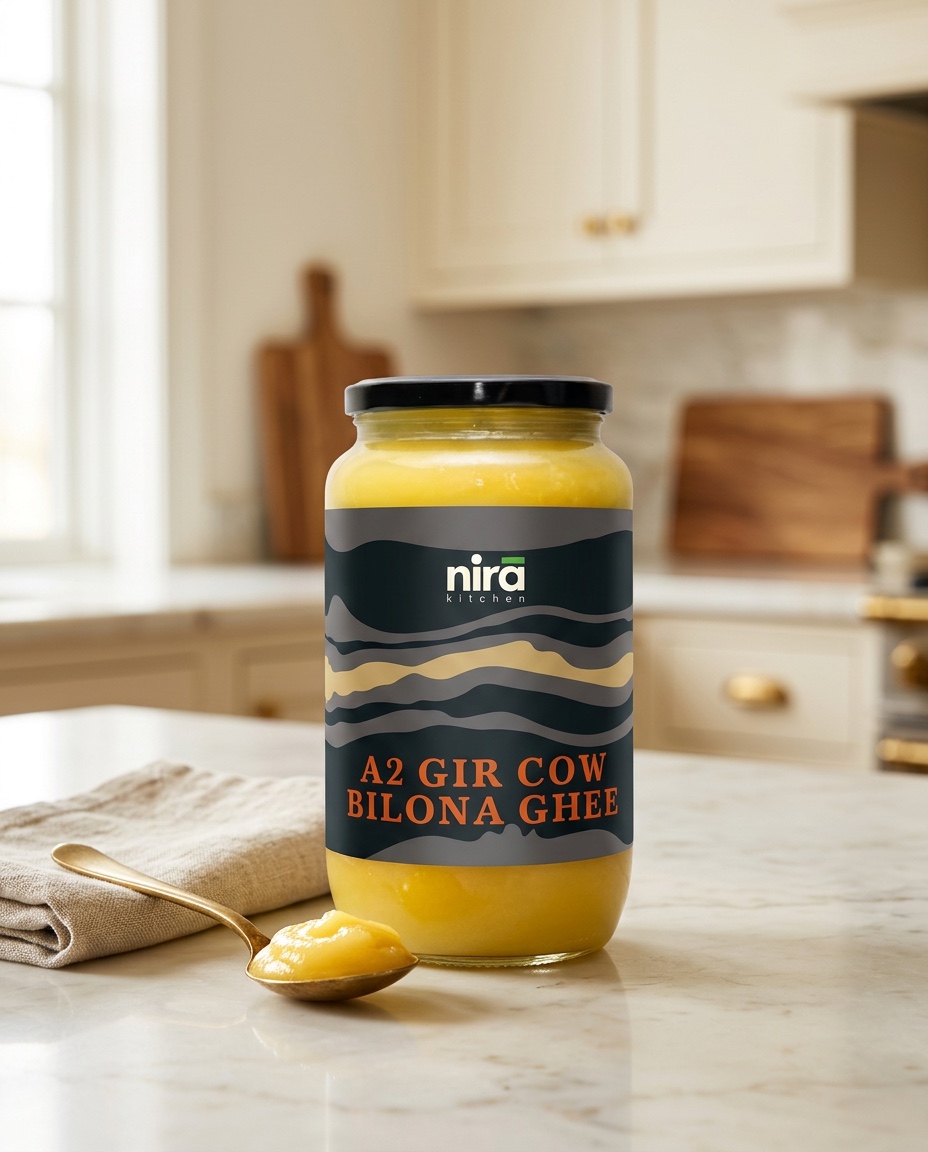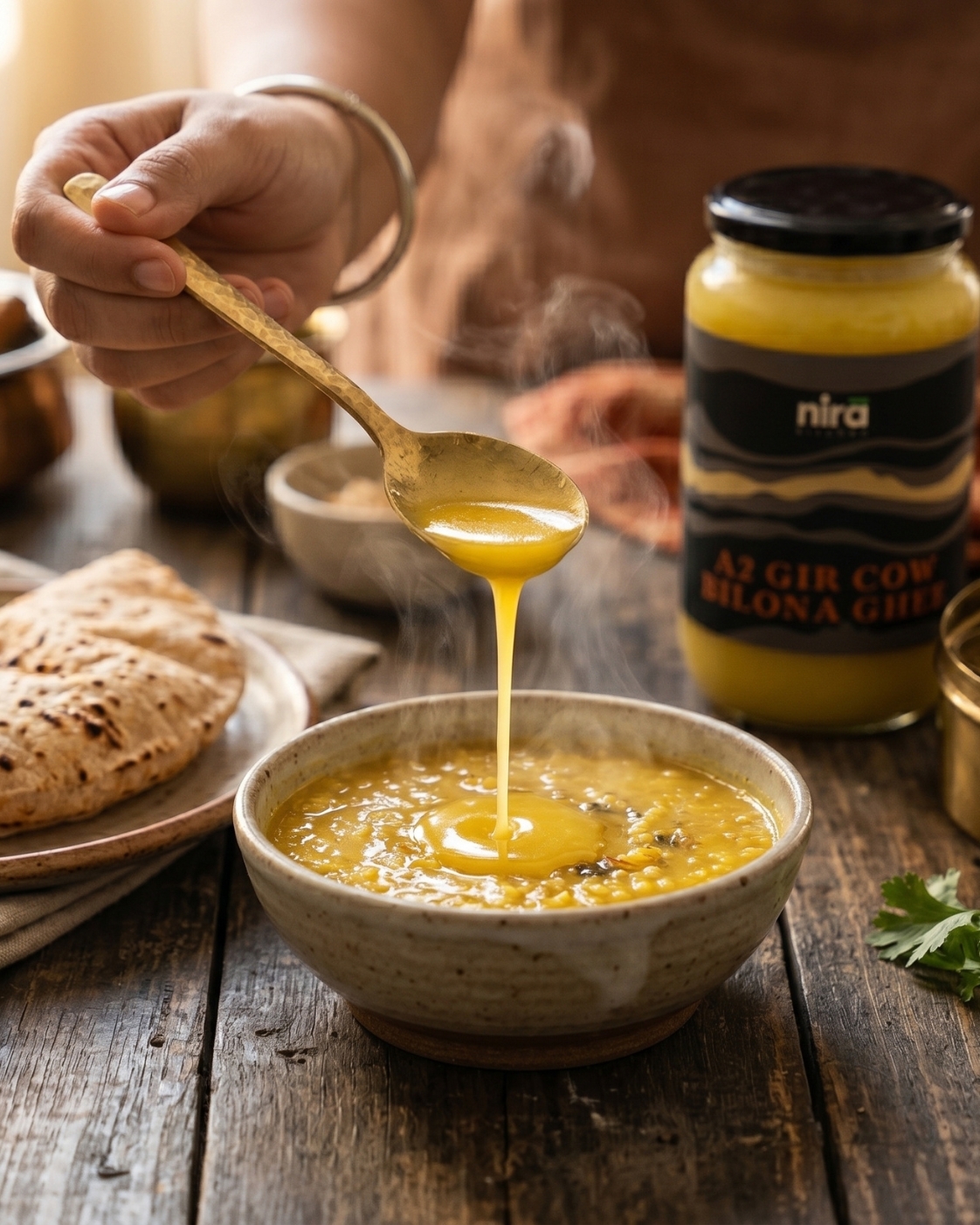


In the Gir region of Gujarat, our partner dairy works with A2 grass-fed cows that graze freely across open land. Their milk is never rushed into industrial processing. Instead, every batch follows the traditional bilona method — the way ghee was prepared in Indian homes across generations, before the factory and the clock changed what was permissible to call patience.
How It Is Made
Fresh milk from a single milking is first set into curd. The curd is then slowly hand-churned over nearly 48 hours to separate makkhan (natural butter) without heat, without a centrifuge, without anything the process did not originally require. This butter is then gently slow-cooked on a low flame until it transforms into rich amber ghee with deep caramel notes and an aroma that moves through a kitchen the way good cooking should: unhurriedly.
It takes nearly 30 kg of curd to produce 1 kg of this ghee. During the slow transformation, milk solids are removed, and casein levels reduce significantly, leaving behind a pure, golden fat that is light, aromatic, and deeply satisfying. It is a yield that makes no commercial sense. It makes every other kind.
“In a world of shortcuts, this is our return to slower nourishment — made with time, intention, and respect for tradition.”
What Ghee Is
Traditionally revered in Indian kitchens and in ritual alike, ghee is one of the few edible fats that melts at body temperature — which makes it uniquely easy to use and uniquely comfortable to eat daily. It has been a fixture in Ayurvedic practice for centuries not because it was the only fat available, but because it behaved differently from every other one.
For us, ghee is more than an ingredient. It is a ritual. A spoon in warm morning meals. A drizzle over fresh rotis. The aroma of a tadka finishing at the table. A nourishing close to dinner. The kind of comfort that passes from one generation to the next, not because it was prescribed, but because it was remembered.
Everyday wellness does not begin with extremes. It begins with what you choose daily.
What It Means on Your Shelf
Grocery-shelf ghee has a flat, oily note and a short finish. A long-churn ghee like this one has three distinct notes — butter, caramel, a hint of grass — and a finish that lingers the way a good olive oil does. You need much less of it to flavour a dish.
- A teaspoon over a dal finishes it more than a tablespoon of supermarket ghee ever would.
- Used in kheer, the ghee carries the milk notes instead of fighting them.
- For parathas, brush it on after the second turn — so the fat stays on top, not inside.
- On warm rice with black pepper and a pinch of salt, it becomes a full meal.
Keeping It
Ghee does not need refrigeration. It keeps for twelve months on a shelf, so long as no water enters the jar. The rule is simple and has no exceptions: a dry spoon every time.