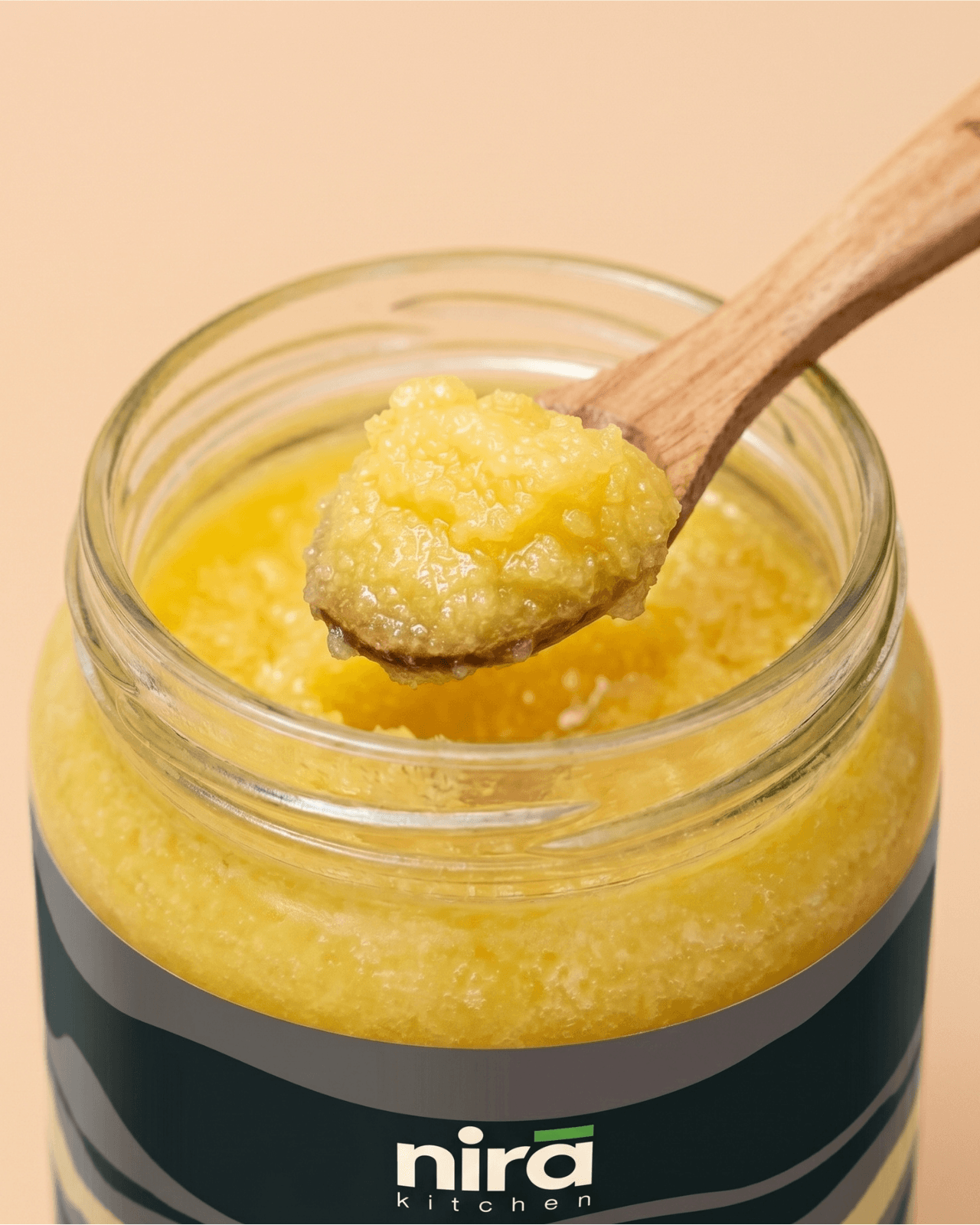

Ghee is the golden cooking fat of the Indian kitchen: butter that has been simmered until its water cooks away and its milk solids turn golden, then strained. What is left is almost pure milk fat, with a nutty smell that fills the house while it cooks.
This guide answers the simple questions people search for: what ghee is called in English and in other Indian languages, how it differs from butter and from Western clarified butter, and why the tin labelled vanaspati is a different product altogether. For how to choose a jar, see our guide to the best ghee in India.
Ghee in English
In English, ghee is most often translated as clarified butter. That is close, but not exact. Clarified butter in Western kitchens is butter that has been melted and separated, with the milk solids skimmed off before they colour. Ghee is cooked for longer, so the milk solids brown slightly before they are strained out. That is where its deeper colour and nutty, caramel-like flavour come from.
So the most accurate short answer is: ghee is a kind of clarified butter, cooked a little further. In English-language recipes and on labels, the word ghee itself is now widely used.
“Ghee is clarified butter, cooked a little further, until it smells of toasted nuts.”
Ghee in Indian languages
The same jar goes by different names across India. These are the ones you are most likely to hear:
- Hindi, Bengali, Gujarati and Punjabi: ghee or ghi (घी).
- Marathi: tup (तूप). Homemade ghee is often called sajuk tup.
- Tamil: nei (நெய்).
- Telugu: neyyi (నెయ్యి).
- Kannada: tuppa (ತುಪ್ಪ).
- Malayalam: ney (നെയ്യ്).
Desi ghee simply means traditional ghee, the kind made at home or by the old methods, as opposed to factory-made fats sold as ghee substitutes.
What ghee is, by the rulebook
In India, the Food Safety and Standards Authority of India (FSSAI) sets a standard for what can be sold as ghee. In plain terms, ghee must be clarified fat made only from milk, curd, desi butter or cream, with no colour or preservative added. The standard also sets a minimum of 99.5 percent milk fat and a maximum of 0.5 percent moisture.
That low moisture is why ghee keeps well in a cupboard. With almost no water left in it, there is little for spoilage to work on, as long as the jar is kept clean and dry.
Ghee vs butter: the difference
Ghee is made from butter, but the two behave very differently in the kitchen:
- What is in it. Butter is mostly milk fat, with water and milk solids mixed through it. Ghee is almost all milk fat, because the water is cooked off and the solids are strained out.
- Heat. Because the milk solids are gone, ghee can be heated well past the point where butter browns and burns. That is why it suits a tadka, frying and roasting.
- Flavour. Butter tastes fresh and creamy. Ghee tastes nutty and rounded, from the solids that browned while it cooked.
- Storage. Butter needs the fridge. Ghee keeps at room temperature in a clean, airtight jar.
In baking and on toast, butter and ghee can often stand in for each other. For high heat, ghee is the better choice.
Is vanaspati ghee?
No. Vanaspati is often called vanaspati ghee, but it is not made from milk at all. It is refined vegetable oil that has been hydrogenated, a process that makes the oil solid at room temperature so it looks and handles a little like ghee. It is sold as a cheaper substitute.
Because the two are easy to confuse, Indian food rules do not allow vanaspati to be coloured to look like ghee. On a label, look for the words ghee, desi ghee or cow ghee and a milk source. If the ingredient list names vegetable oils, it is not ghee.
Cow ghee, buffalo ghee and A2 ghee
Ghee can be made from the milk of cows or buffaloes, and the two look different: cow ghee is usually a deeper golden yellow, buffalo ghee paler, almost white. A2 ghee is cow ghee made from milk that carries only the A2 type of beta-casein, usually from native breeds such as Gir. Our guides to the best ghee in India and to what A2 ghee is explain the differences in more detail.
How ghee is made
There are two common routes. Most ghee is made by melting cream or butter and simmering it until the water is gone and the solids turn golden. The traditional bilona method starts a step earlier: whole milk is set into curd, the curd is churned by hand into butter, and that butter is simmered into ghee. It takes much longer, and the flavour is different.
Our ghee
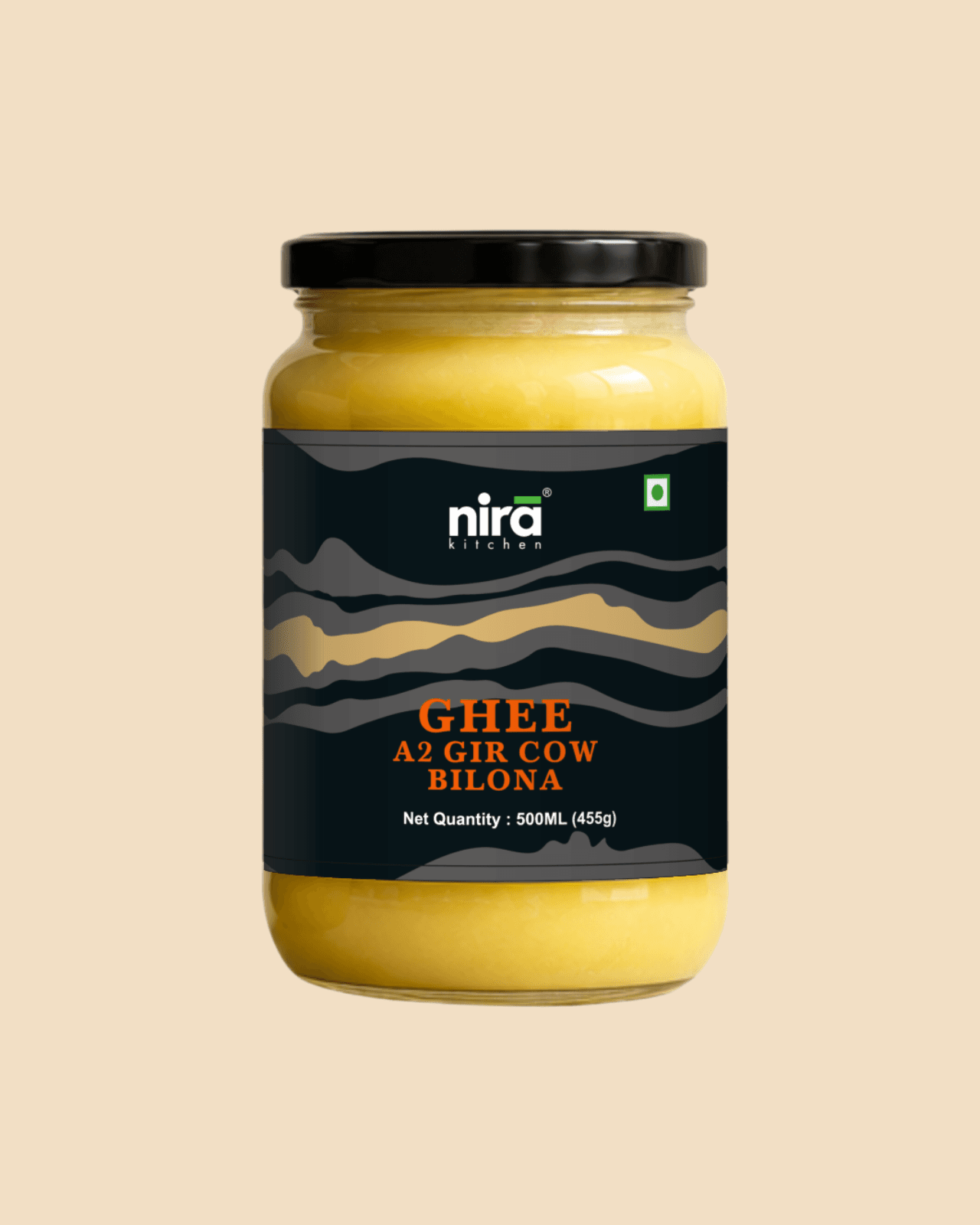
nira kitchen's ghee is made from the A2 milk of grass-fed Gir cows in Gujarat. A partner dairy sets whole milk into cultured curd, hand-churns it by the bilona method and simmers the butter into ghee. Nothing is added. A sample was tested by EFRAC, an NABL-accredited laboratory.
Whatever you buy, the label tells you most of what you need: the word ghee, a milk source, no vegetable oils, an FSSAI licence and recent dates.