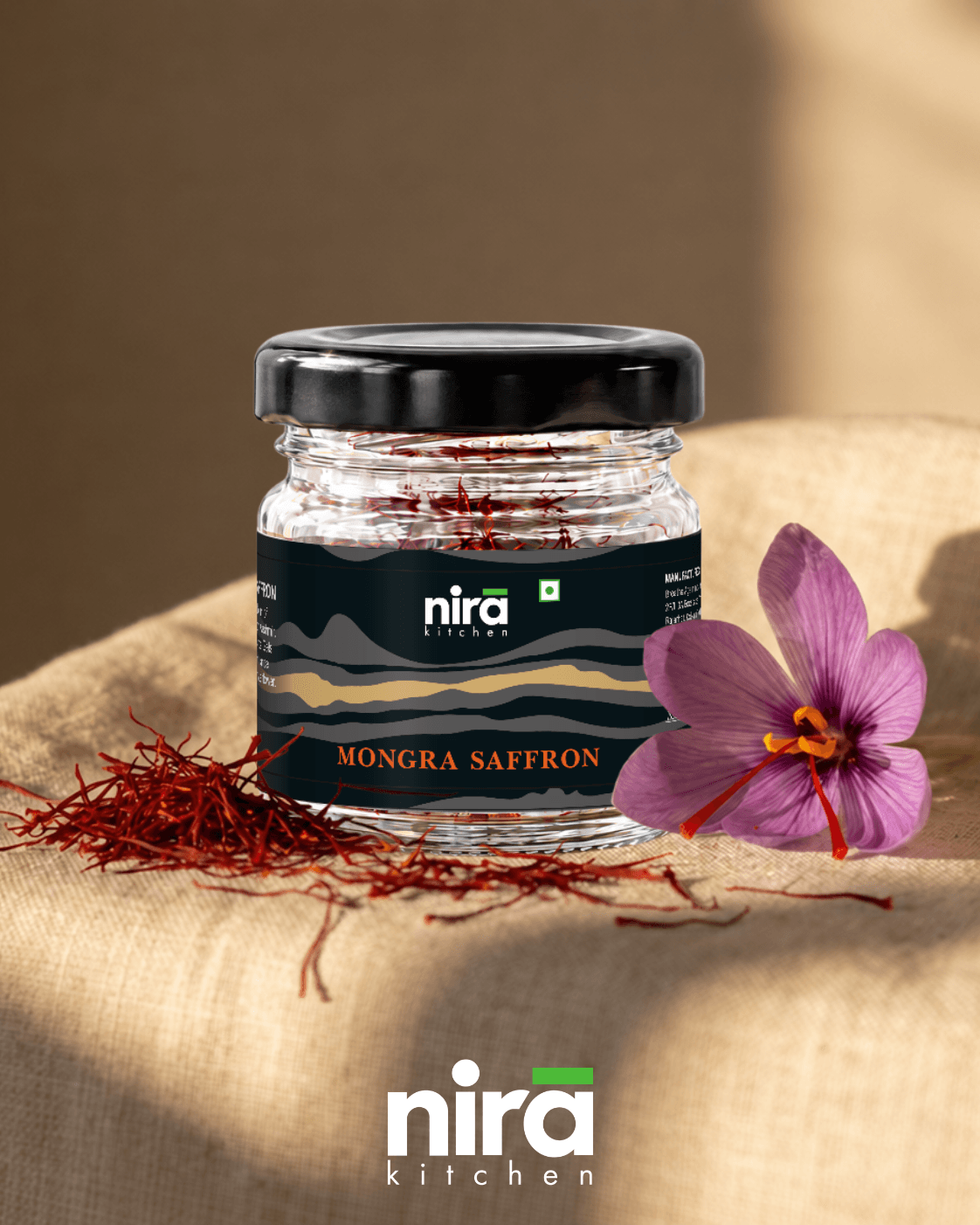

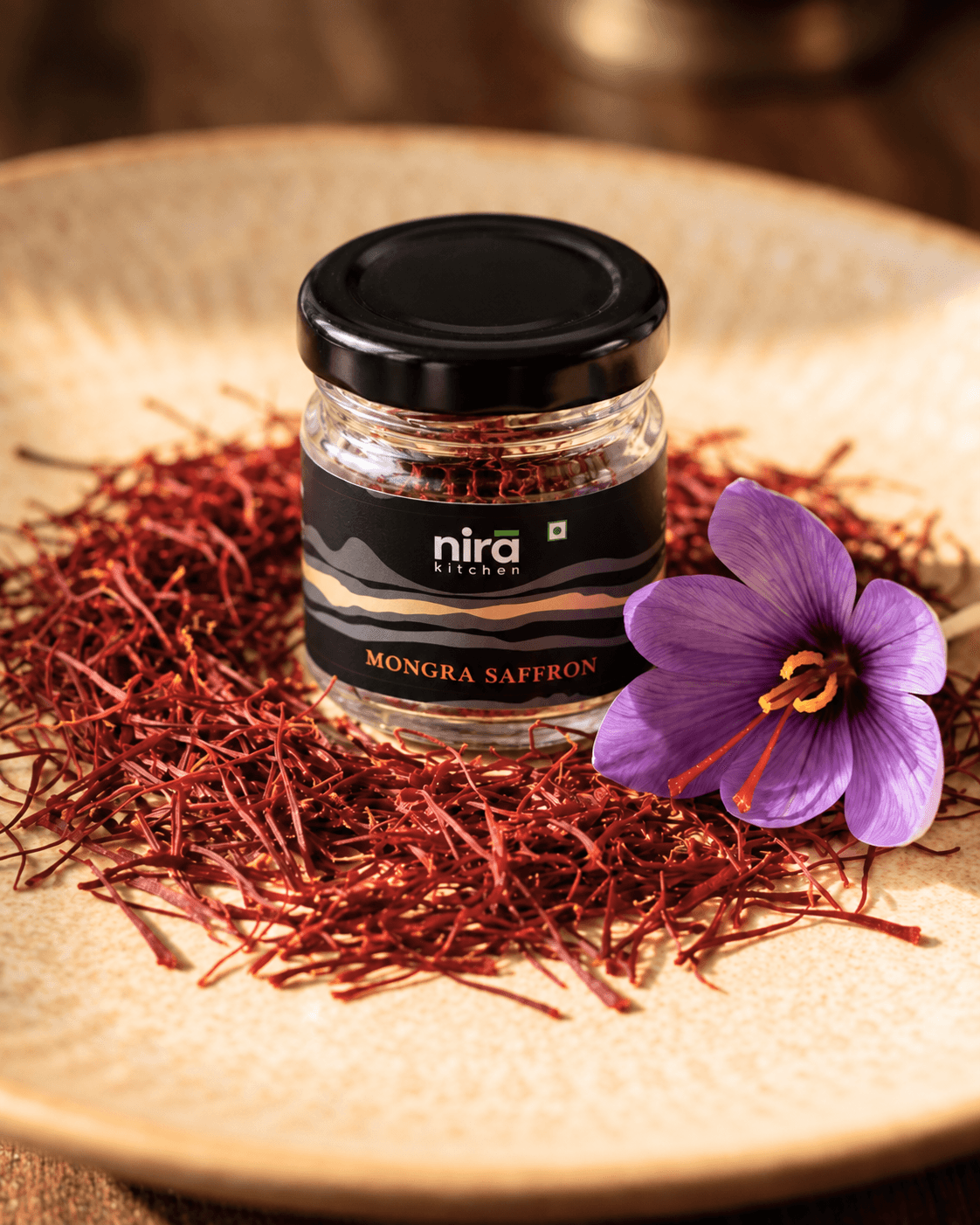
Saffron is the dried red stigma of a small purple flower, the saffron crocus. In Hindi it is kesar. It is one of the oldest and most costly spices in the world, and in Indian kitchens it turns up in a few spoonfuls of kheer, a pot of biryani or a glass of warm milk, a handful of threads at a time.
This guide answers the simpler questions behind it: what saffron actually is, what it is called across India, what the flower looks like, and how kesar is grown and picked in the Kashmir Valley. If you want to know what it should cost, see our kesar price guide. If you want to test a tin at home, see how to check pure saffron.
Saffron in Hindi and other Indian languages
The same spice goes by many names across India. These are the ones you are most likely to see on a label or hear in a shop:
- Hindi and Marathi: kesar (केसर).
- Urdu: zafran, from the Persian zafarān, which is also where the English word saffron comes from.
- Tamil: kungumapoo (குங்குமப்பூ).
- Telugu: kumkuma puvvu (కుంకుమ పువ్వు).
- Malayalam: kunkumam (കുങ്കുമം).
Whatever the name, it means the same thing: the dried red threads of the saffron crocus. Kesar is not a colour or a flavouring added to food. When a sweet is described as kesar flavoured, it should mean real saffron went into it.
The saffron flower
The saffron flower is a crocus, Crocus sativus. It is small and low to the ground, with six pale purple petals. Inside each flower are three parts that matter:
- Three deep-red stigmas. These are the saffron threads.
- A pale yellow style, the stalk that joins the three stigmas at the base.
- Three yellow stamens, which carry pollen. They look a little like saffron but are not used.
The saffron crocus cannot make seeds. Every plant grown today comes from an underground bulb called a corm, which divides into new corms each season. That means saffron cannot simply be sown in a field. It has to be planted, lifted and replanted by hand, corm by corm.
The flowers open in autumn, often at dawn, and start to wilt the same day. A field can look bare one evening and purple the next morning, which is why the picking has to be done quickly.
“Three red threads from each purple flower. That is all saffron is.”
Where kesar is grown in India
In India, saffron is grown mainly in the Kashmir Valley, on the raised plateau land known as karewa around Pampore, near Srinagar. The soil there drains well, and the cool autumn nights of the valley are what bring the flowers up.
Kashmir grows only a small share of the world's saffron. Iran grows most of it, and Spain has long been a centre for trading and packing it. Small amounts are also being grown experimentally in other parts of India.
How kesar is grown and harvested in Kashmir
Kesar ki kheti, the growing of saffron, follows the seasons closely. In outline, the year goes like this:
- Summer: corms are planted in raised beds, usually around August, with narrow channels around each bed so water does not collect.
- September: the corms need moisture, so a dry September can mean a thin harvest. Much of the crop depends on rain.
- Late October to mid-November: the flowers come up as the nights cool, usually from the last fortnight of October into the first fortnight of November.
- Every morning of the bloom: pickers walk the beds early and pick the open flowers by hand into baskets.
- The same day: the red threads are separated from the petals of each flower by hand, before the flowers wilt.
- Drying: the fresh threads are dried slowly until they are light and brittle, which concentrates the colour and aroma.
The corms stay in the ground after the flowers fade and multiply below the surface. From time to time growers lift them, divide them and replant, and the cycle starts again.
How kesar is made: from flower to thread
There is no machine for most of this. Each flower gives only three threads, and it takes roughly 150 flowers to make a single gram of dried saffron. A 2 g tin of saffron is the work of around 300 flowers, each one picked and opened by hand.
After drying, Kashmiri saffron is traditionally sorted by how much of the thread is kept. Mongra is only the deep-red top of the stigma, trimmed clean. Lachha keeps the red stigma with some of the paler yellow style still attached. Our price guide explains how much the cut changes what you pay.
What gives saffron its colour, taste and smell
Three natural compounds in the stigma do most of the work, and each one is why saffron behaves the way it does in the kitchen:
- Crocin gives the colour. It dissolves in water and milk, which is why real saffron turns warm milk golden-yellow slowly.
- Picrocrocin gives the taste. It is slightly bitter, which is why a thread on the tongue tastes bitter even though it smells sweet.
- Safranal gives much of the aroma, the smell often described as honey and dry hay. It fades with light, heat and age.
This is also why steeping matters. Crushing a few threads and soaking them in warm milk or water for 15 to 20 minutes lets the colour and aroma come out before they go into the pot.
How kesar is used in Indian cooking
A little goes a long way. For a dish that serves four, 8 to 10 threads is usually enough. Some of the most familiar ways to use it:
- Kesar milk: threads steeped in warm milk, often with a little sugar and crushed nuts.
- Kheer, phirni and shrikhand, where saffron gives colour and a gentle aroma.
- Biryani and pulao, with steeped saffron milk poured over the top layer of rice.
- Kahwa, Kashmir's green tea with saffron, cardamom and almonds.
- Sweets such as kesar peda and jalebi, and festive desserts.
Keep saffron in an airtight tin, away from light, heat and steam, and reach in with dry fingers or a dry spoon. Light and moisture are what dull it.
Our saffron
nira kitchen's saffron is Kashmiri Mongra: only the red stigma tips, hand-picked in the Kashmir Valley, from the karewa fields around Pampore, and packed in 2 g tins. A sample was lab-tested by EFRAC, an NABL-accredited laboratory, and found to meet FSSAI standards for saffron, including no added colour.
If you are buying kesar for the first time, start with a few threads in a small bowl of warm milk. A slow golden colour, red threads and a smell of honey and hay are what real saffron looks like.