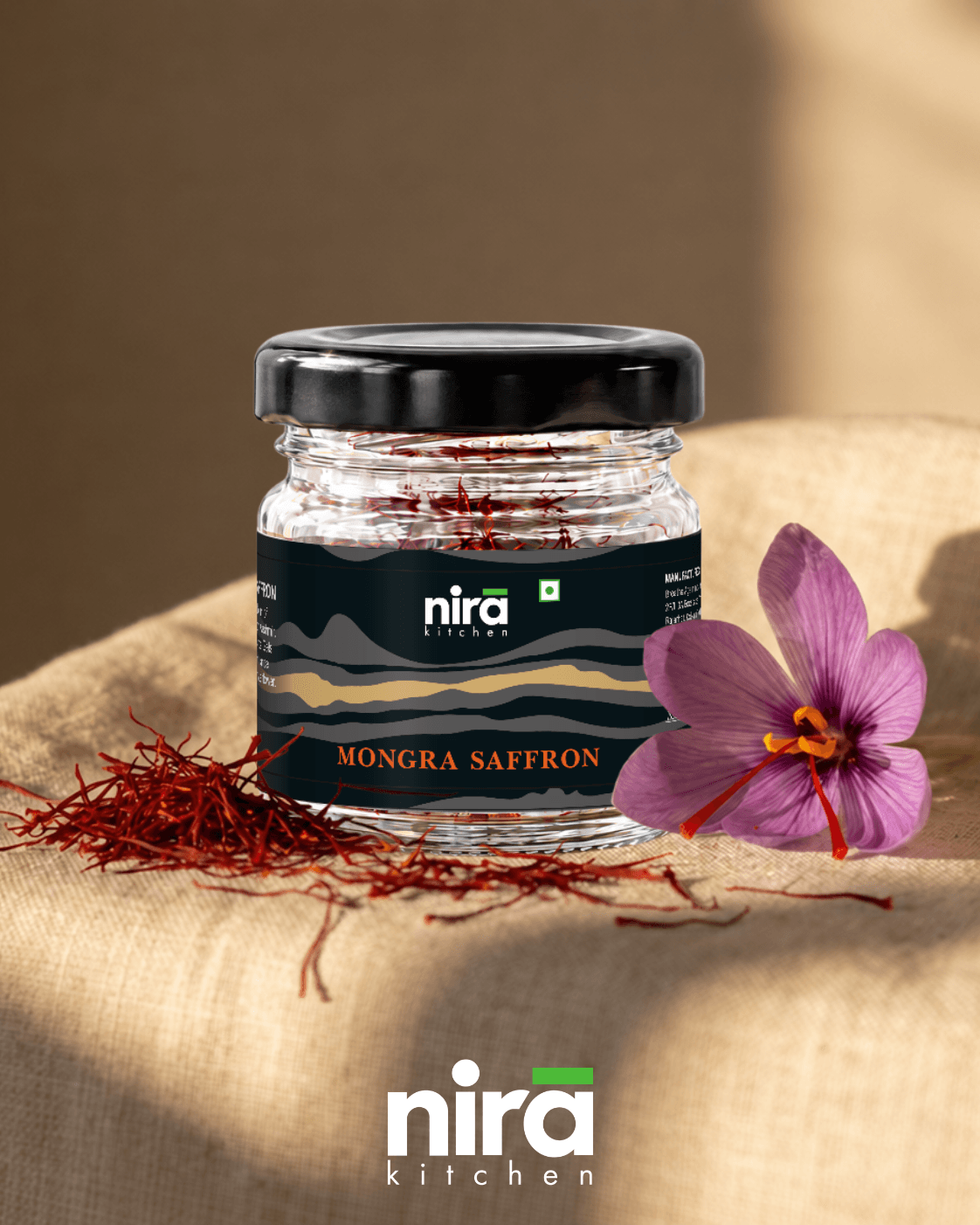

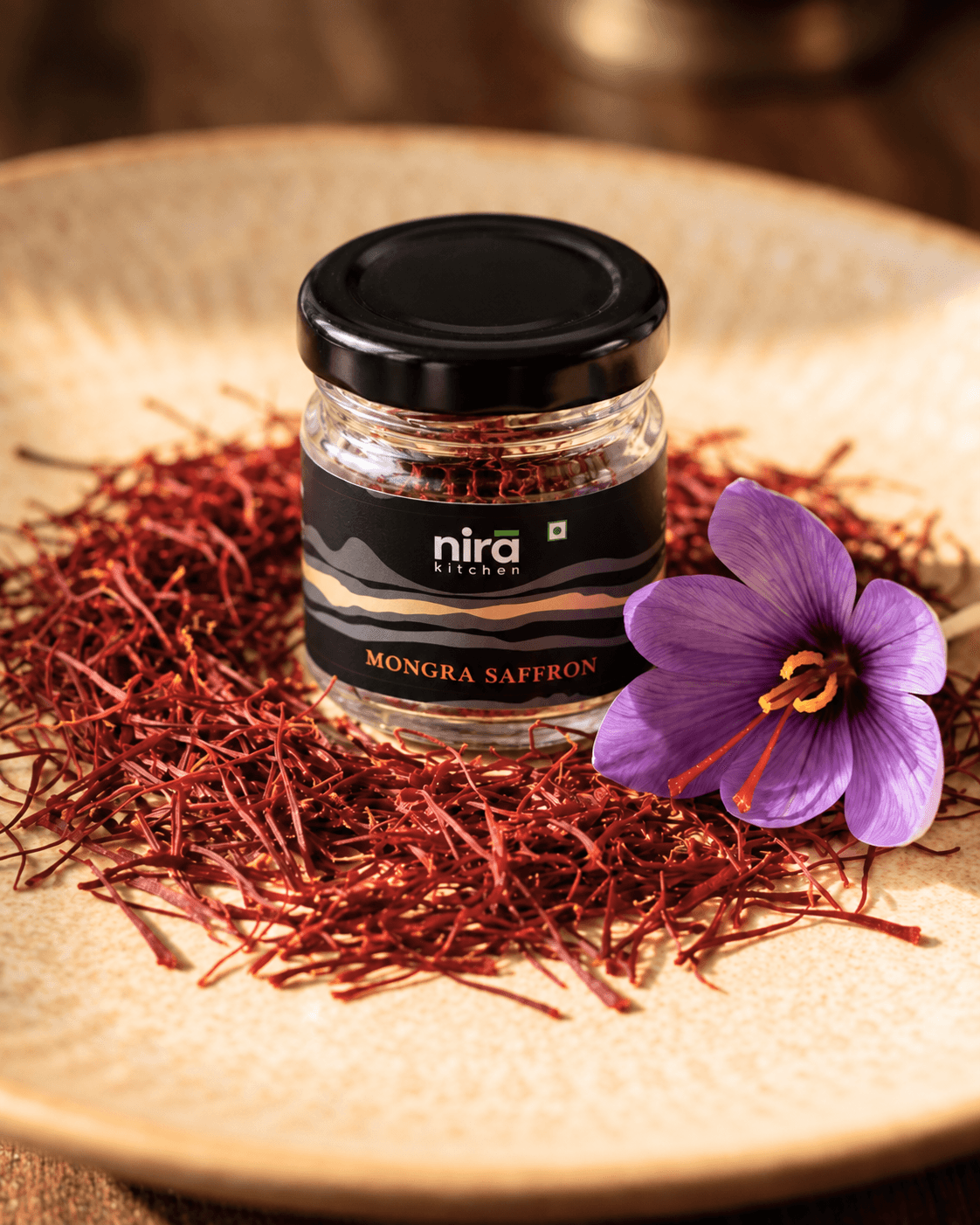
If you have searched for the kesar price lately, you will have seen numbers that make little sense side by side. One 1 gram tin costs ₹210, another ₹800, and a social post says saffron sells for lakhs a kilogram. All of these can be true at once. Saffron is priced by the gram, sold in tiny quantities, graded loosely and copied often.
This guide sets out what we found when we checked prices, what drives the spread, and how to tell whether the saffron in front of you is worth what it costs.
What 1 gram of kesar costs in India today
On 28 October 2026 we searched Google India for Kashmiri saffron and noted every listing that stated both a price and a pack size. Across 17 such listings, Kashmiri saffron sold for roughly ₹210 to ₹800 a gram. The median was about ₹400 a gram, and most listings sat between ₹330 and ₹450.
- 1 gram: roughly ₹210 to ₹800, with most 1 g tins between ₹330 and ₹450.
- 10 grams: the one 10 g pack we found was listed at ₹3,590. At the median of about ₹400 a gram, 10 g works out to about ₹4,000.
- 1 kilogram: at ₹400 a gram, a kilogram works out to about ₹4 lakh (₹4,00,000). Across the full range we saw, that is roughly ₹2.1 lakh to ₹8 lakh.
Two cautions. The kilogram figures are our own multiplication, not a wholesale rate, and almost nobody buys a kilogram at retail. And online prices move with the harvest, festivals and discounts, so read these numbers as a snapshot of one day rather than a rate card.
Larger packs were usually a little cheaper per gram. A 5 g pack we saw came to about ₹343 a gram and a 50 g pack to about ₹320 a gram, against ₹359 to ₹449 for many 1 g tins with similar descriptions.
Why saffron is expensive at all
Saffron is the dried stigma of the saffron crocus, Crocus sativus. Each flower carries just three stigmas, and they are picked out by hand soon after the flower opens. It takes roughly 150 flowers to make a single gram of dried saffron.
The flowers bloom for only a few weeks in autumn, and picking, separating and drying are all done by hand. There is no shortcut, which is why even ordinary saffron costs more per gram than almost anything else in an Indian pantry.
Why kesar prices vary so much
Once you accept that saffron is costly, the next question is why one gram can cost nearly four times another. Four things do most of the work.
The cut. In Kashmir, saffron is traditionally sorted by how much of the thread is kept. Mongra is only the deep-red top of the stigma, trimmed clean. Lachha keeps the red stigma with some of the paler yellow style still attached, so a gram holds less red. Zarda is the yellow style on its own, with little of the colour and aroma people pay for. Mongra costs the most because more flowers go into every gram of pure red.
Powder sits outside this ladder altogether. Once saffron is ground, you cannot see what went into it, which is why we suggest buying threads.
The origin. In India, saffron is grown mainly in the Kashmir Valley, on the karewa fields around Pampore. Iran grows most of the world's saffron, and Spain has long been a centre for trading and packing it. Kashmiri saffron is grown in small quantities and sells at a premium in India, which is also why "Kashmiri" is the word most often stretched on labels.
How it is sold. Most saffron in India comes in 0.5 g, 1 g and 2 g tins, and smaller packs cost more per gram. Some older shops still quote by the tola, which is about 11.66 grams, so a tola price can look alarming next to a 1 g tin until you divide it out.
Adulteration. Very cheap saffron is usually cheap for a reason. Common fakes include safflower petals, corn silk and other plant fibres dyed red, as well as real saffron bulked out with the yellow style or coated to make it heavier. Powder can be mixed with other colourants. When a gram costs a fraction of the going rate, it is worth asking what you are actually paying for.
“Saffron is the one spice where the cheapest gram is rarely the best value.”
How to compare saffron prices fairly
- Work out the price per gram. Divide the price by the number of grams before you compare anything else.
- Read the pack size carefully. A listing that says pack of 2 may mean two 0.5 g tins. The total grams are what matter.
- Compare threads with threads. Powder and threads are not the same product, and powder is much harder to judge.
- Compare cut with cut. A Mongra price and a Lachha price are not like for like.
- Look for a lab report. Ask whether a sample was tested against FSSAI standards for saffron, including a check for added colour.
- Check the dates. Saffron loses aroma over time, so look for a packing date and a best-before date, not only a price.
How to check real kesar at home
You do not need a laboratory to catch the most common fakes. Three simple checks will do most of the work.
The warm water or milk test. Drop three or four threads into a small bowl of warm water or milk, not boiling. Real saffron releases its colour slowly: a golden-yellow that spreads over several minutes and keeps deepening. The threads themselves stay red. Dyed threads tend to bleed red colour straight away and turn pale as the dye washes out. If the water turns red within seconds, be suspicious.
The smell. Good saffron has a sweet smell that people often describe as honey and dry hay, with something faintly floral underneath. Fakes tend to smell of very little, or of dye.
The taste. Put a single thread on your tongue. Real saffron tastes slightly bitter, even though it smells sweet. A distinctly sweet taste can mean sugar has been added to make it heavier.
None of these checks replaces a lab report, but together they will catch most dyed fakes in your own kitchen.
How much kesar you actually use
This is the part that makes the price easier to live with. Each flower gives three threads, so a gram holds roughly 450 of them. For most dishes that serve four, such as a biryani, a pot of kheer or kesar milk, a pinch of 8 to 10 threads is enough.
To get the most from each pinch, crush the threads lightly and steep them in two or three tablespoons of warm milk or water for 15 to 20 minutes before they go into the pot. The colour and aroma spread far more evenly than if you scatter dry threads.
At 8 to 10 threads a dish, a 2 g pack covers something like 90 dishes. Seen that way, the gap between a ₹350 gram and a ₹700 gram is a few rupees per dish. That is small next to the difference between saffron you can trust and saffron you cannot.
Store saffron in an airtight tin, away from light, heat and moisture, and always reach in with dry fingers or a dry spoon.
What we sell, and why
nira kitchen's saffron is Kashmiri Mongra: only the red stigma tips, hand-picked in the Kashmir Valley and packed in 2 g tins. A sample was lab-tested by EFRAC, an NABL-accredited laboratory, and found to meet FSSAI standards for saffron, including no added colour. It has a shelf life of 24 months from packaging.
We do not print our price here because prices change. See the current price on the product page, and divide it by two to compare it per gram with anything else you are considering.
Whatever you buy, the method in this guide holds: price per gram, threads not powder, the cut named, a lab report, a recent date, and a slow golden colour in warm milk.