
The best ghee in India is not one jar on one shelf. It is the jar that suits the way you cook, made from milk and by a method you can name, with a label that answers your questions. Ghee is sold everywhere, from the corner shop to the dairy counter, and the range of colour, aroma and price can be bewildering.
This is a buyer's guide. It covers cow and buffalo ghee, the main ways ghee is made in India, what to look for on a label, which home checks are worth doing, why prices vary so much and how to store a jar once it is home.
Which ghee is best: start with what you cook
Before comparing jars, decide what you want the ghee to do. If it goes into tadka, onto rotis and over hot dal and rice, aroma matters most, because you will taste it in every spoonful. If it is mostly for frying or for large batches of mithai, a milder ghee at a lower price may serve you better. Many kitchens keep two: a fragrant ghee for the table and an everyday one for the stove.
Cow ghee vs buffalo ghee
The first split on any shelf is the animal. Both make good ghee, and they behave differently in the kitchen.
- Colour: cow ghee is golden-yellow. Buffalo ghee is white or a pale cream. A very white jar labelled cow ghee is worth a second look.
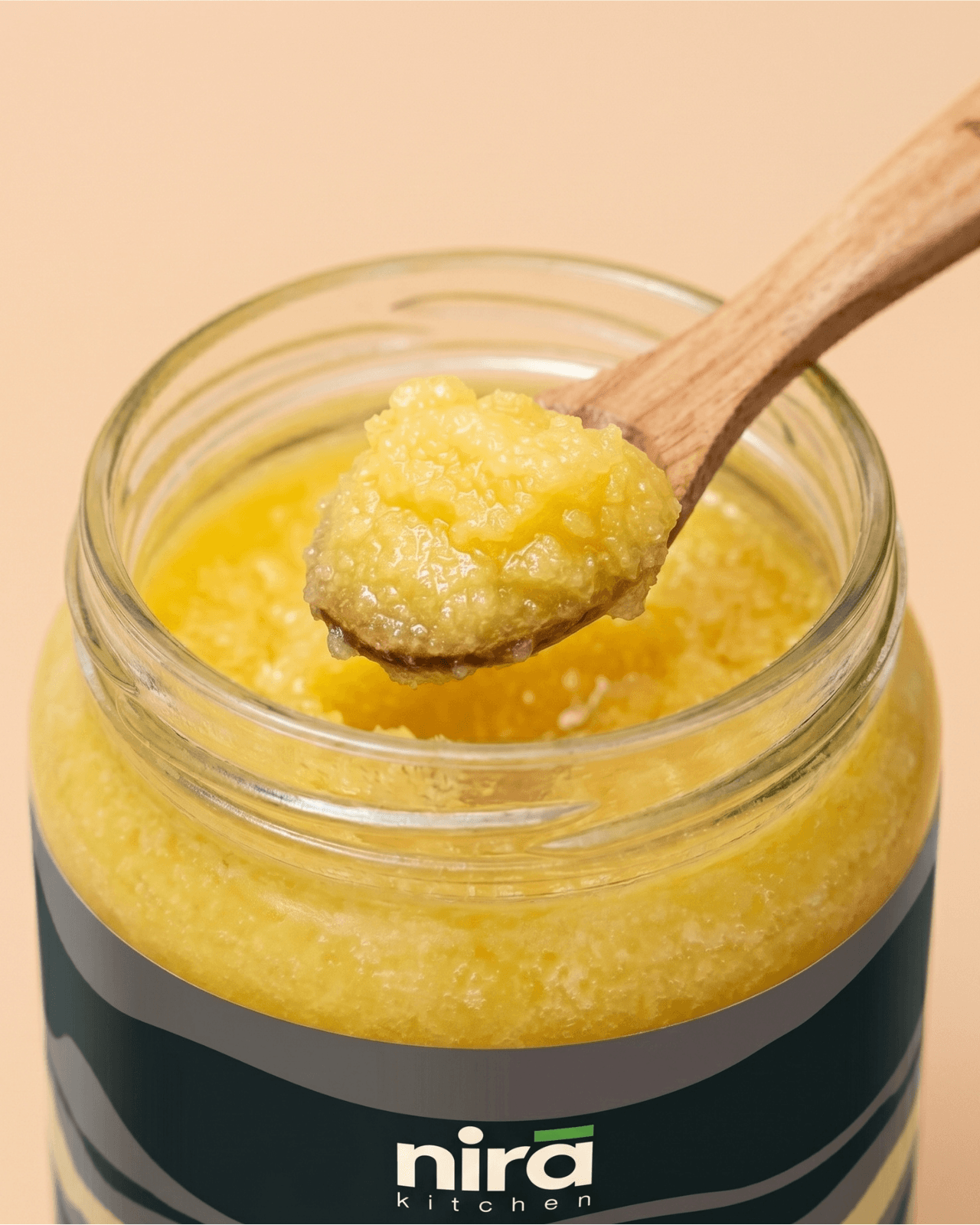
- Texture: buffalo milk is richer in fat, and its ghee tends to set thicker and denser. Cow ghee is often softer, and bilona cow ghee usually sets with a grainy, danedar texture.
- Aroma: cow ghee generally has a more pronounced, nutty aroma. Buffalo ghee is milder and smells more of cream.
- Typical uses: many households reach for cow ghee for tadka, rotis, dal and rice, and for buffalo ghee in halwa, laddoo and other sweets, or for frying, where its richness and lower price suit larger quantities.
Desi ghee, a word you will see on many jars, simply means traditional Indian ghee. It does not tell you the animal, the breed or the method, so read on past it.
How ghee is made in India
The method shapes taste, texture and price more than almost anything else. There are four you will meet.
Bilona. Whole milk is set into curd, the curd is churned until butter separates, and the butter is simmered into ghee. A2, by contrast, is about the milk: it means milk from cows that carry only the A2 type of beta-casein, usually native breeds such as Gir. For more on both terms, see our guide to A2 ghee. Bilona ghee tends to taste deeper and slightly tangy, set grainy, and cost the most, because churning curd recovers less butter from each litre of milk.
Malai or cream. The household way in many Indian homes: the layer of malai that forms on boiled milk is collected over days, sometimes cultured, then churned or heated. The ghee is rich and homely, and its character depends on how the malai was kept.
Butter. White butter, made by churning cream, is heated slowly until the water cooks off and the milk solids brown. Good butter gives a clean, sweet ghee.
Direct cream. The common industrial route. Cream is separated from milk by machine and heated directly into ghee, without making butter first. It is efficient, gives the most ghee per litre and usually the mildest flavour and smoothest texture. It is why most supermarket ghee is affordable, and there is nothing wrong with it as a method.
“The animal and the method shape a jar of ghee far more than the word on the front.”
A label checklist
A jar should answer most of your questions before you open it. Here is what we look for.
- The ingredient line. Ideally one ingredient: cow milk fat, or buffalo milk fat. Mixed milk should be stated as such. Added flavour, colour or other fats have no place in ghee.
- The animal and breed. Cow or buffalo at the very least. If a jar claims A2, it should name the breed, such as Gir or Sahiwal.
- The method. Bilona, cream or butter. If a brand claims bilona, it should say how the curd was set and churned.
- The FSSAI licence number. Every packaged food sold in India must carry one. Its absence is a reason to put the jar back.
- Packing and best-before dates. Fresher is better. Check both, not just the expiry.
- A lab report. Ask whether a sample was tested and for what. A brand that has done the work will usually share it.
- Agmark. Some ghee carries the Agmark grading mark. It is a voluntary mark, so its absence does not mean a ghee is poor, but its presence means the ghee was graded against a government standard.
How to check pure ghee at home
Home checks can flag crude adulteration. They are rough, and each has limits. Use a small sample and a clean, dry spoon.
- The melt test. Warm a teaspoon of ghee in a small pan over low heat. Pure ghee melts quickly into a clear, golden liquid. If it melts slowly, stays cloudy or leaves a residue, something else may be mixed in. Limit: the milk solids left in a home-made ghee can also cloud it a little.
- The set test. Melt a spoonful in a small glass bowl and let it set at room temperature or in the fridge. Pure ghee sets evenly, often with a grainy texture. If it separates into distinct layers, a vegetable fat may have been added. Limit: ghee naturally sets in a mix of grains and liquid on warm days, which is not the same as clear layers.
- The aroma test. Warm a little and smell it. Good ghee smells nutty and lightly caramelised. A flat, waxy or oily smell is a warning. Limit: aroma is subjective, and a mild direct-cream ghee can smell faint without being impure.
- The iodine test. A commonly cited check for added starch, such as mashed potato. Stir a few drops of iodine tincture into a little melted ghee. If it turns blue or purple, starch is likely present. Limit: it detects starch and nothing else.
What home checks cannot tell you matters just as much. They cannot tell cow from buffalo milk once the colour has been masked, confirm a breed or an A2 claim, detect small amounts of a well-chosen foreign fat, or tell you whether the method on the label is true. Only the brand's sourcing and a laboratory test can do that.
Why ghee prices vary so much
You will find ghee across a wide price range, and most of the difference has three causes.
- The milk. Milk from native breeds such as Gir costs more, because the cows give less milk than the high-yield breeds in large commercial dairies. Buffalo milk, with more fat per litre, gives more ghee for the same quantity.
- The method. Bilona needs far more milk per jar than direct cream, because churning curd recovers less butter.
- The scale. A large plant processing cream by the tonne spreads its costs widely. A small dairy setting curd and churning by hand cannot.
A high price alone does not prove quality. But a jar claiming A2, bilona and a named breed at the price of ordinary ghee deserves questions.
How to store ghee
Ghee does not need refrigeration. Keep it in a clean, airtight jar in a cool, dark cupboard, away from the stove and sunlight. Always use a dry spoon, because a drop of water or a crumb of food is what usually spoils a jar. It will soften in summer and set firmer in winter, which is normal. If a jar ever smells sour or sharp, it has gone rancid and should be thrown away.
Our ghee
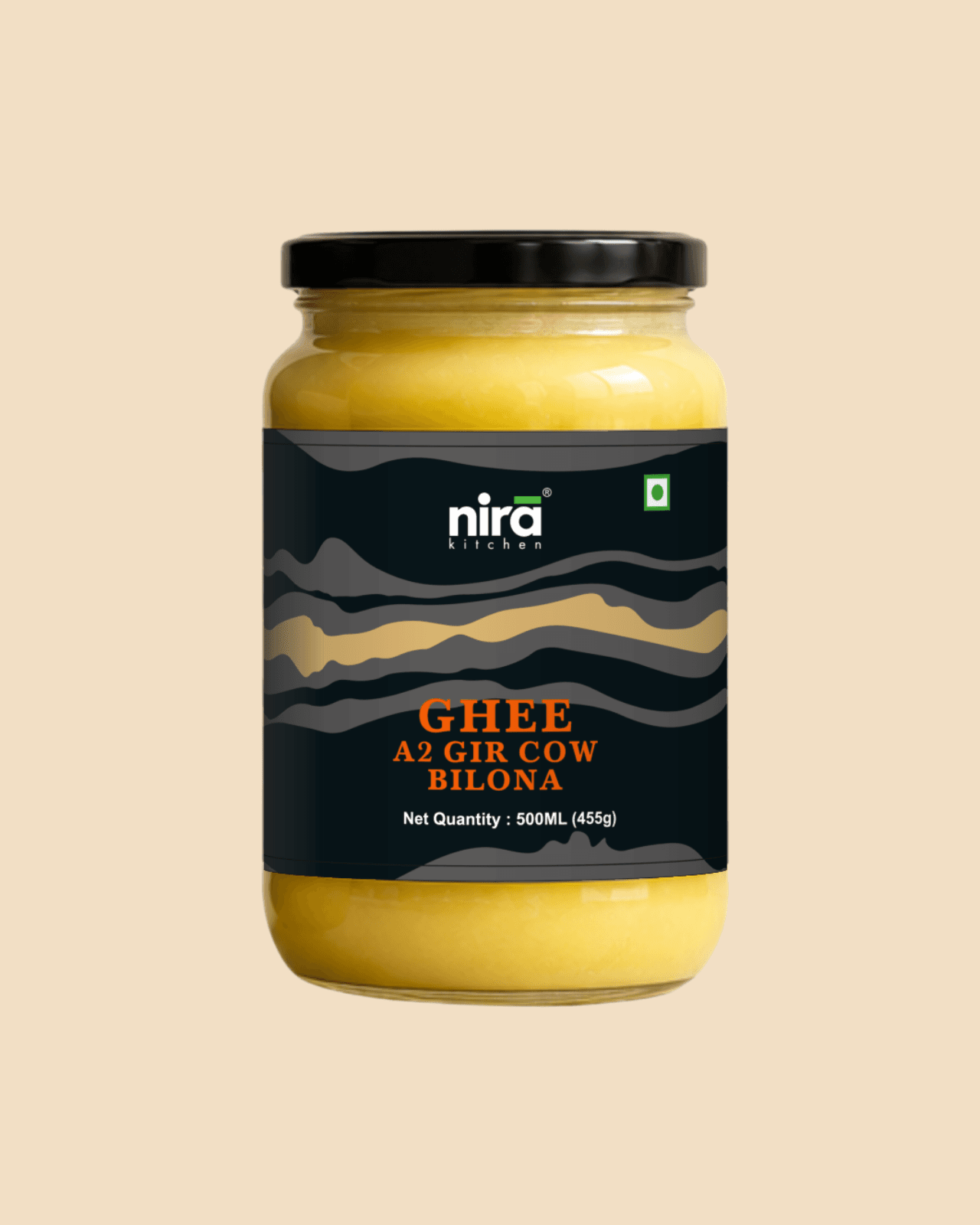
nira kitchen's ghee is made from the A2 milk of grass-fed Gir cows in Gujarat. A partner dairy sets whole milk into cultured curd, hand-churns it by the bilona method and simmers the butter into ghee. Nothing is added.
The A2 claim is backed by a test, and separately, a sample of the ghee was lab-tested by EFRAC, an NABL-accredited laboratory. It needs no refrigeration; just use a dry spoon. You will find the current price and full details on the product page.