
Knowing how to check pure saffron is worth more than any label. Kesar is costly by the gram, sold in tiny tins and easy to copy, so fakes turn up everywhere from local markets to online listings. The good news is that the most common fakes can be caught in your own kitchen with a bowl of warm milk, a magnifying glass and a little patience.
This is a hands-on guide: what real saffron is, what the fakes are made of, the home tests that are most often used, what each one shows and where each one stops. If you are comparing prices, see our kesar price guide.
What real saffron is
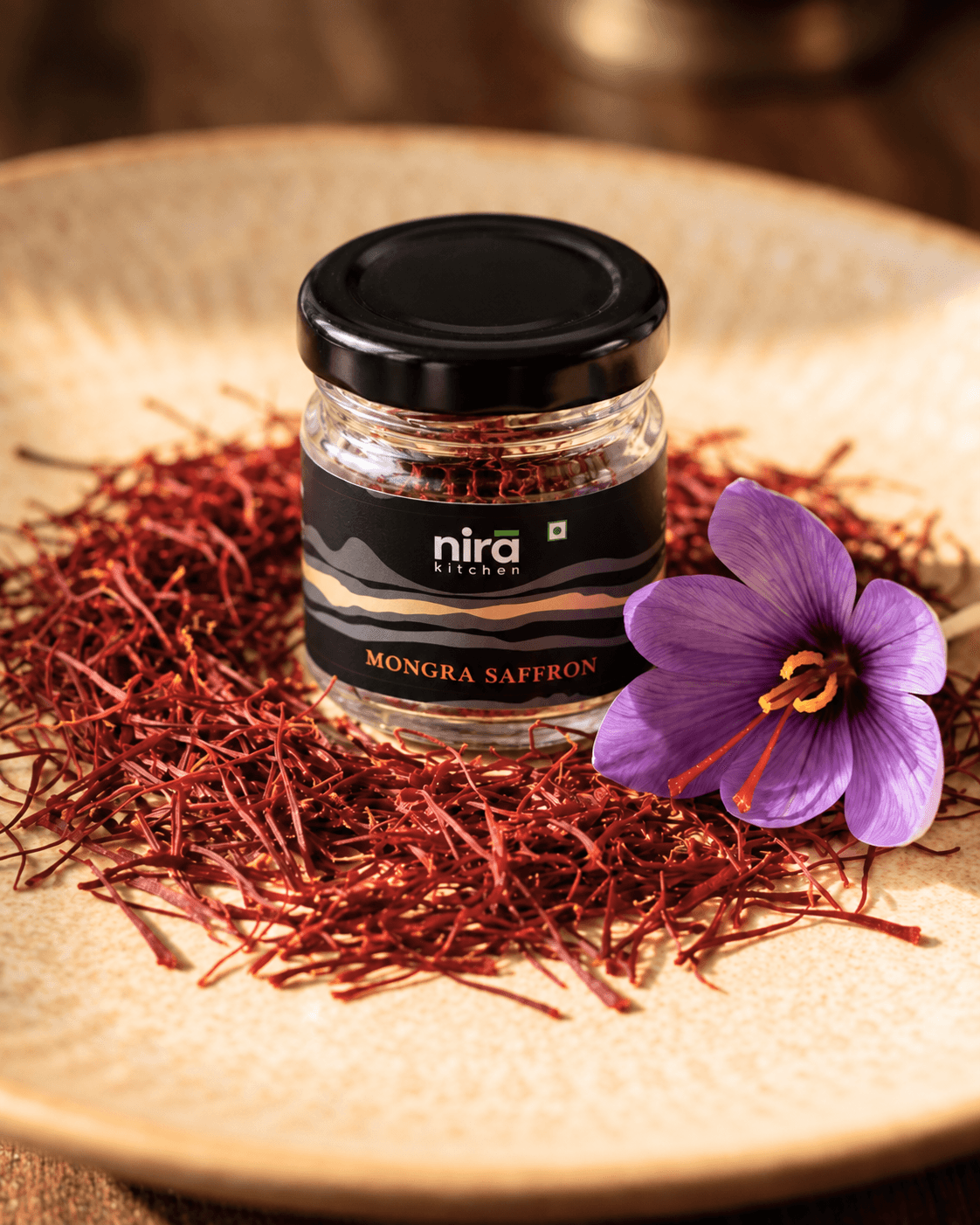
Saffron is the dried stigma of the saffron crocus, Crocus sativus. Each purple flower carries three deep-red stigmas, joined at the base to a paler yellow style. They are picked out by hand soon after the flower opens and then dried.
In Kashmir, saffron is traditionally sorted by how much of the thread is kept:
- Mongra: only the deep-red top of the stigma, trimmed clean. The most colour and aroma per gram.
- Lachha: the red stigma with some of the yellow style still attached.
- Zarda: the yellow style on its own, with little of the colour or aroma people buy saffron for.
Knowing these cuts matters for testing, because a tin of Lachha will rightly contain some yellow, while a tin sold as Mongra should be red.
The common fakes
Fake saffron is rarely subtle once you know what to look for. These are the forms most often described:
- Dyed corn silk: the fine threads from a corn cob, coloured red.
- Safflower petals: often sold as saffron. The petals are flatter and more orange-red.
- Coloured paper, grass or other plant fibres cut to look like threads.
- Real saffron padded with extra yellow style, so a gram holds less of the red stigma.
- Real threads coated with oil, glycerine, sugar or honey to add weight.
- Saffron powder mixed with colourants or other spices such as turmeric or paprika.
Powder is the hardest to judge because you cannot see what went into it. That is why we suggest buying threads.
Test 1: warm water or milk
This is the original kesar test most families know, and the most useful. Drop three or four threads into a small bowl of warm water or milk, not boiling, and watch.
Real saffron releases its colour slowly. A golden-yellow haze spreads from each thread over several minutes and keeps deepening for a while. The threads themselves stay red.
Dyed fakes usually bleed red or orange-red colour almost at once, and the threads turn pale or white as the dye washes out. If the water goes red within seconds, be suspicious.
Its limits: some dyes are more stable and release colour more slowly, and the test cannot tell you the cut or where the saffron was grown.
“Real saffron colours milk golden-yellow, slowly. The thread stays red.”
Does real saffron float?
You will often read that real saffron floats and fake sinks, or the other way round. Whether a dry thread floats at first depends a lot on how dry it is and on surface tension, so we do not rely on floating or sinking either way. Watch the colour instead.
Test 2: the thread shape
Take a few dry threads and look at them closely, ideally under a magnifying glass or with your phone camera zoomed in.
A real saffron stigma is a slim thread, thin at one end and flaring out into a small trumpet or funnel at the other, often with a slightly frilly edge. You may find clusters of three joined at the base. Threads should be a deep, even red, with a little yellow only where the style is attached, depending on the cut.
Corn silk is uniform along its length, with no trumpet. Safflower petals look flat and ribbon-like. Paper and fibres often look too regular, all the same thickness and length.
Its limits: shape tells you a thread is a saffron stigma. It does not tell you whether that stigma has been coated or coloured.
Test 3: smell
Open the tin and smell it. Good saffron has a distinctive sweet aroma, usually described as honey and dry hay, with something faintly floral underneath. Fakes tend to smell of very little, or of dye or dust.
Its limits: aroma fades with age and poor storage, so old real saffron can smell weak too.
Test 4: taste
Put a single thread on your tongue. Real saffron tastes slightly bitter, even though it smells sweet. If a thread tastes distinctly sweet, sugar or honey may have been added to make it heavier.
Its limits: taste is subjective, and it only takes one thread to be misleading. Use it alongside the other checks.
Test 5: the rub test
Soak a thread in a little water for a few minutes, then lift it out and rub it between your finger and thumb. Real saffron usually stays intact and leaves a yellow-orange stain on your skin. Many fakes break down into pulp or leave a red stain.
Its limits: like the milk test, it catches crude dyes best.
There are other folk tests shared online, such as mixing saffron with baking soda. We have left them out because we are not confident about how reliable they are.
What home tests cannot tell you
Home tests are good at catching dyed corn silk, petals and paper. They are much less good at the harder questions:
- Origin. No home test can tell Kashmiri saffron from saffron grown elsewhere.
- Cut and padding. A small amount of extra style mixed into a tin is easy to miss.
- Stable dyes. Some colourants hold fast and release colour slowly, like real saffron.
- Coatings in small amounts, which add weight without changing the look much.
This is where a laboratory comes in. FSSAI sets standards for saffron in India, and a lab test against those standards checks the saffron itself and looks for added colour. When you buy, ask whether a sample was tested, by which laboratory and against which standard. A brand that has done the work will be able to tell you.
How to store saffron
- Keep it in an airtight tin or jar, so it does not take on moisture or lose aroma.
- Keep it in the dark, away from sunlight and bright kitchen lights, which fade the colour.
- Keep it dry and cool, away from the stove and the steam of the kitchen.
- Reach in with dry fingers or a dry spoon.
Stored this way, saffron keeps its colour and aroma well, but it is still best used within its best-before date.
Our saffron
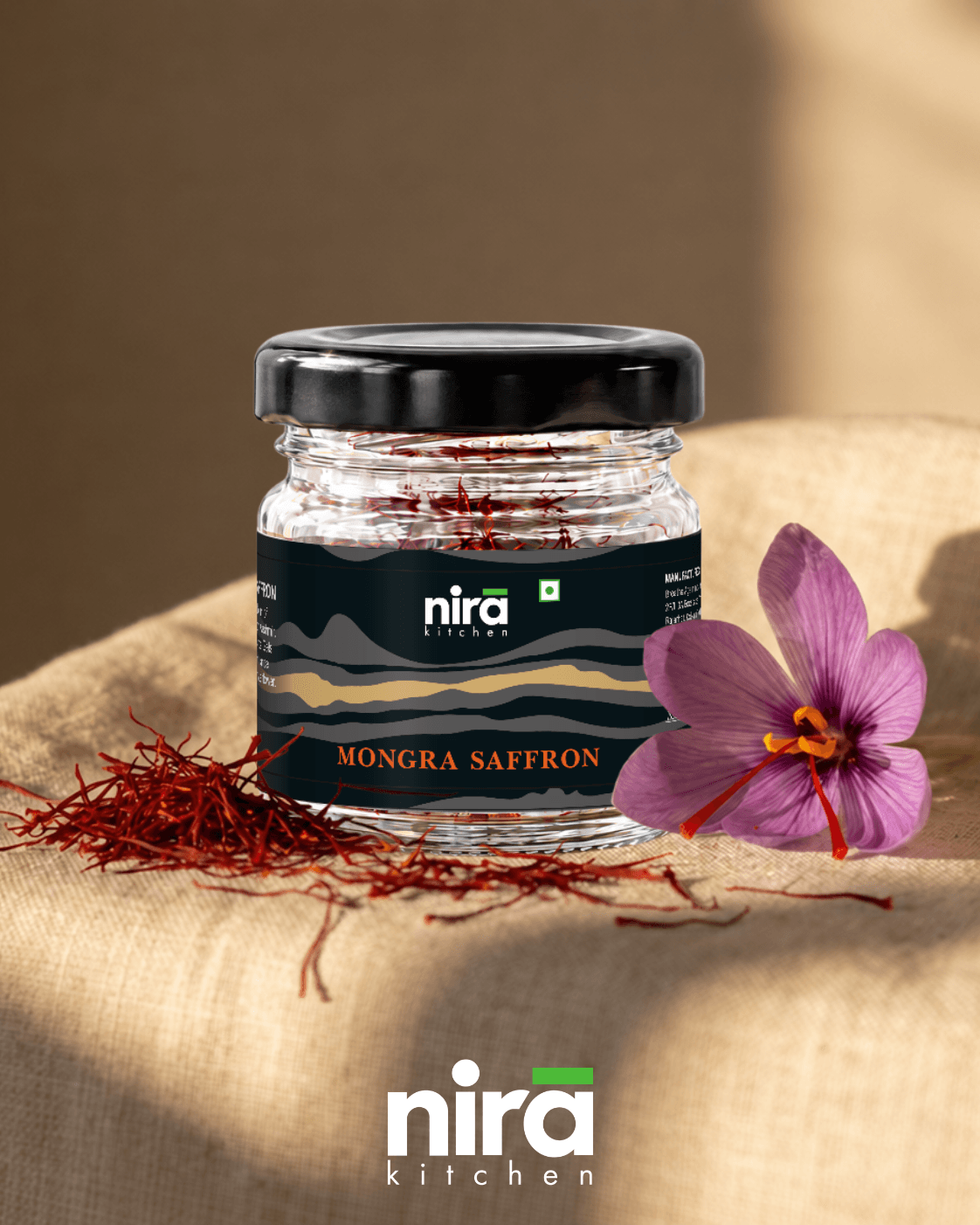
nira kitchen's saffron is Kashmiri Mongra: only the red stigma tips, hand-picked in the Kashmir Valley, from the karewa fields around Pampore, and packed in 2 g tins. A sample was lab-tested by EFRAC, an NABL-accredited laboratory, and found to meet FSSAI standards for saffron, including no added colour. It has a shelf life of 24 months from packaging.
We would still encourage you to try the warm milk test on it. Three threads, a small bowl and a few minutes: a slow golden colour and threads that stay red are what you should see from any saffron worth buying.