
If you have looked up the ghee price lately, you will have seen a 1 litre tin for under ₹400 and a 250 ml jar for more than ₹700. Both are ghee. Both can be honest. Ghee is sold by the millilitre and by the gram, in packs from 100 ml to 15 kg, and the words on the front, desi, A2, bilona, Gir, describe very different jars.
This guide sets out what we found when we checked prices, why the spread is so wide, and how to put two jars side by side and know which one is the better buy for you.
What 1 litre of ghee costs in India today
On 28 October 2026 we searched Google India for desi cow ghee price, A2 ghee, A2 cow ghee and bilona ghee, and noted every listing that stated both a price and a pack size. We then worked out a price per litre for each. Some ghee is sold by weight, so we converted grams to litres at about 910 g to a litre, which is roughly what a litre of ghee weighs. All of the per-litre and per-kg figures here are our own arithmetic.
- Regular cow or desi ghee, with no A2 or bilona claim: across 11 listings, roughly ₹340 to ₹1,645 a litre, with a median of about ₹835 a litre (about ₹920 a kg).
- Bilona ghee that does not claim A2: across 9 listings, roughly ₹916 to ₹2,048 a litre, with a median of about ₹1,275 a litre (about ₹1,400 a kg).
- A2 cow ghee that does not name its method: across 9 listings, roughly ₹698 to ₹2,396 a litre, with a median of about ₹1,600 a litre (about ₹1,760 a kg).
- A2 ghee made by the bilona method: across 15 listings, roughly ₹1,000 to ₹3,250 a litre, with a median of about ₹2,300 a litre (about ₹2,530 a kg).
We did not find buffalo or mixed-milk ghee listings that stated both a price and a pack size, so we cannot give a fair range for them. And the cheapest regular cow ghee we saw came from discounted 1 litre tins, so read the bottom of that range as a sale price rather than a normal one.
As with any online price, these are a snapshot of one day. Ghee prices move with milk prices, festivals and discounts.
What the words on the jar mean for price
Two words do most of the work in the higher price bands. A2 describes the milk: it comes from cows whose milk carries only the A2 type of beta-casein, usually native Indian breeds such as Gir. Bilona describes the method: whole milk is set into curd, the curd is churned to butter, and the butter is simmered into ghee. Our guide What Is A2 Ghee? explains both in more depth.
The ranges above show how these words stack. Bilona alone sits above regular ghee. A2 alone sits a little higher again. A jar that claims both A2 and bilona had the highest median in our check, at nearly three times that of regular cow ghee.
Why the spread is so wide
The milk. Native breeds such as Gir generally give less milk per cow than the high-yield breeds kept in large commercial dairies, so their milk costs more to begin with. Every litre of ghee carries that cost forward.
The method. Most supermarket ghee is made by separating cream from milk by machine and heating it into ghee. That recovers the most fat from each litre of milk. Setting curd and churning it recovers less butter, so a litre of bilona ghee needs considerably more milk than a litre of cream ghee.
The batch size. A large dairy heats cream by the tonne. A small dairy setting curd overnight, churning and simmering in open pans can make only so much in a day, and someone has to watch every batch.
The pack. Small jars cost more per litre than large ones, and glass jars and steel dolchis cost more than tins or tetra packs. In our check, the highest per-litre prices often came from 100 ml and 250 ml jars, while 5 litre packs of the same kind of ghee came in lower.
“A price per litre only means something when you know whose milk and which method.”
How to compare ghee prices fairly
Pick one unit and stick to it. We use price per litre, because most jars are sold by volume. If a jar is sold by weight, divide the grams by 910 to get litres. A 1 kg jar holds about 1.1 litres of ghee, so a 1 kg jar at ₹1,100 and a 1 litre jar at ₹1,000 cost about the same.
- Work out the price per litre. A 500 ml jar at ₹900 is ₹1,800 a litre. A 250 ml jar at ₹600 is ₹2,400 a litre.
- Read the pack size twice. Combos, buy one get two and pack of 5 listings can hide the real quantity.
- Check the animal. Cow, buffalo or mixed milk should be stated plainly.
- Check the breed. If a jar claims A2, it should name the breed, such as Gir or Sahiwal.
- Check the method. Bilona, cream or butter. If it says bilona, it should say how the curd was set and churned.
- Find the FSSAI licence number. Every packaged food sold in India must carry one.
- Check the packing and best-before dates, not only the expiry.
- Ask for a lab report. A brand that has done the work will tell you whether a sample was tested, and what for.
Then compare like with like. An A2 bilona ghee and a regular cream ghee are different products, and a jar claiming A2, bilona and a named breed at the price of ordinary ghee deserves a closer look.
How long a jar lasts
Ghee is used a spoon at a time: a spoonful for a tadka, a little over hot dal and rice, a brush over rotis. A teaspoon is about 5 ml, so a 500 ml jar holds roughly 100 teaspoons.
At the regular cow ghee median of about ₹835 a litre, a teaspoon works out to about ₹4. At the A2 bilona median of about ₹2,300 a litre, it is about ₹11.50. These are our own sums. They do not make a costly jar cheap, but they show the gap per spoon is smaller than the gap per jar.
A short note on storage
Ghee does not need refrigeration. Keep it in a clean, airtight jar in a cool, dark cupboard, and always use a dry spoon, because water or a crumb of food is what usually spoils a jar. If you buy a large pack to save per litre, decant a small jar for daily use and keep the rest sealed.
What we sell, and why
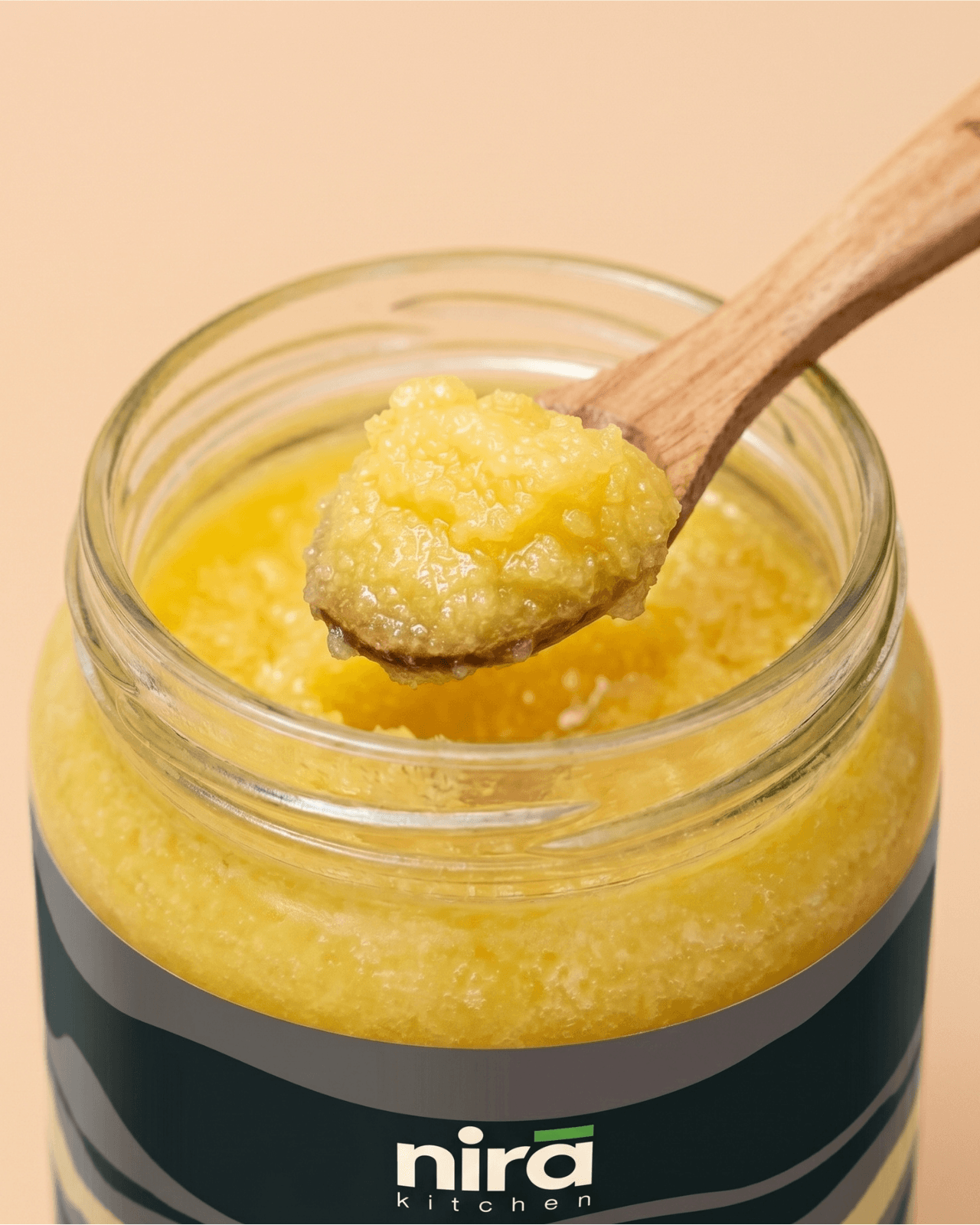
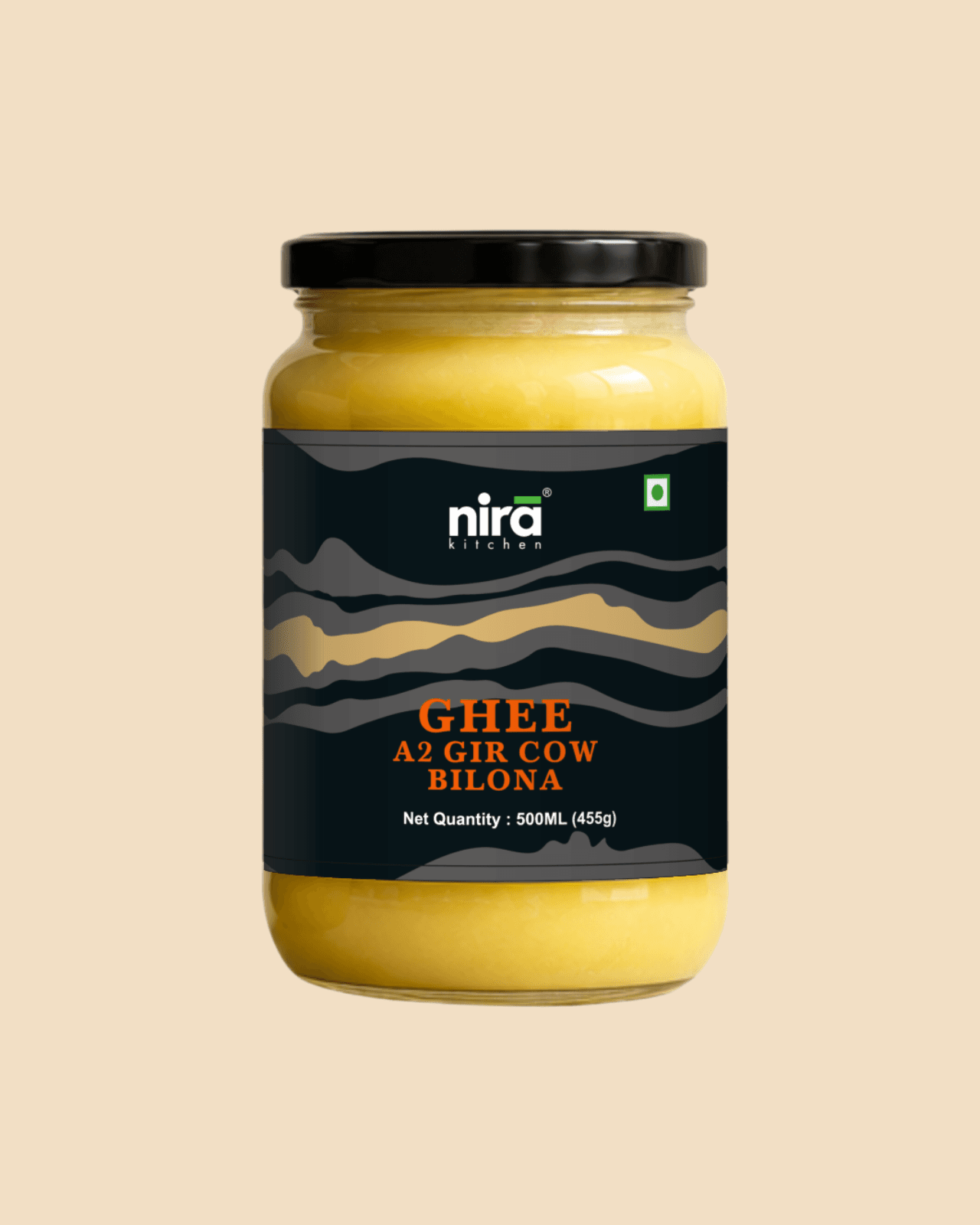
nira kitchen's ghee is made from the A2 milk of grass-fed Gir cows in Gujarat. A partner dairy sets whole milk into cultured curd, hand-churns it by the bilona method and simmers the butter into ghee. Nothing is added.
The A2 claim is backed by a test, and separately, a sample was tested by EFRAC, an NABL-accredited laboratory. It comes in 500 ml and 1 litre jars.
We do not print our price here because prices change. See the current price on the product page, and work it out per litre to compare it with anything else you are considering.
Whatever you buy, the method in this guide holds: price per litre, the animal and breed named, the method stated, an FSSAI licence, recent dates and a lab report.