

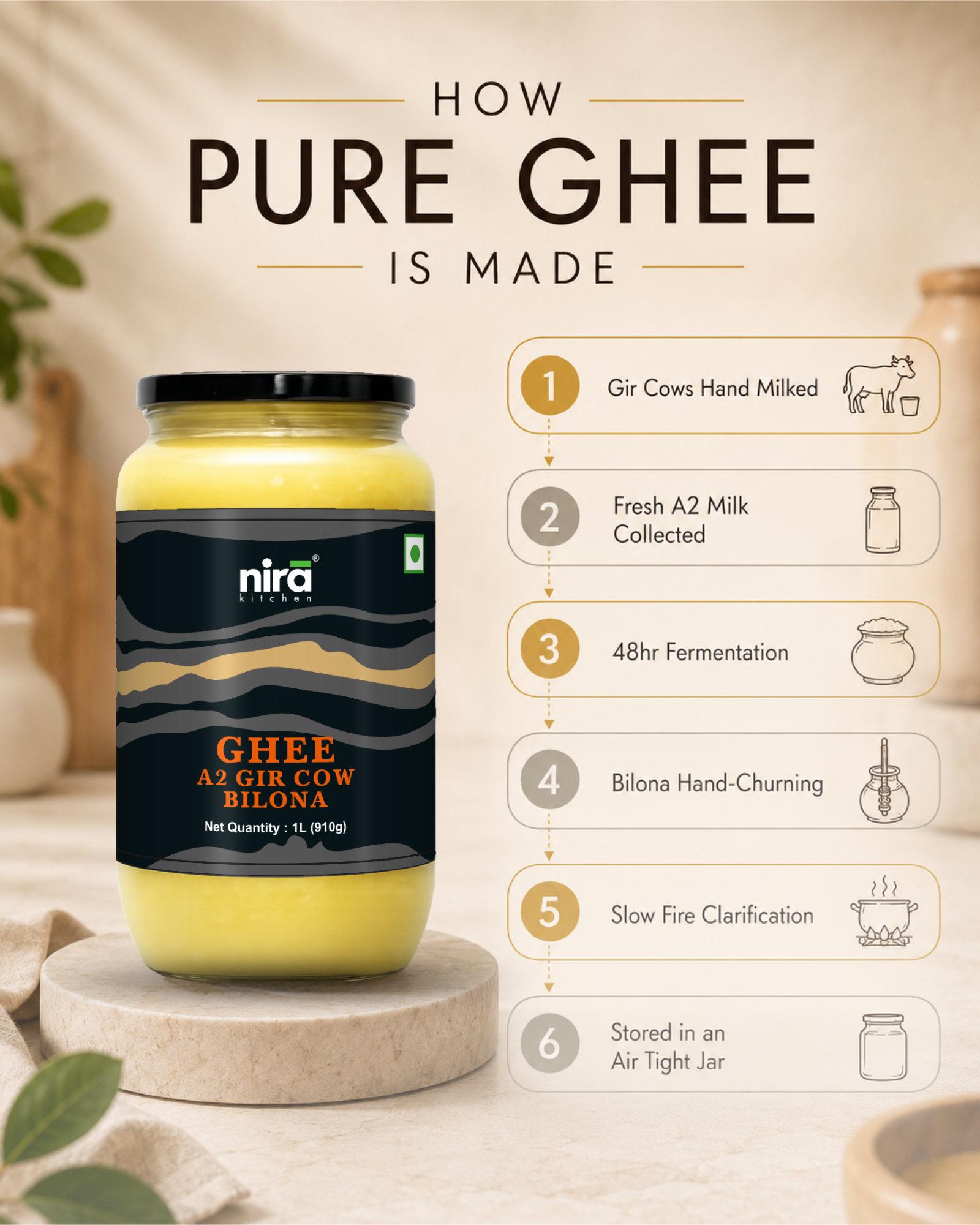
Gir cow ghee is ghee made from the milk of the Gir, one of India's oldest native cattle breeds, named after the Gir hills and forests of Gujarat. On a jar, the word Gir is a claim about the cows: not just cow milk, but milk from one named breed. It is a more specific claim than desi and a more checkable one than A2 on its own.
This guide covers where the breed comes from, how to recognise a Gir cow, how much milk she gives, what her milk has to do with A2, and how to check a Gir cow ghee before you pay for it.
Where the Gir cow comes from
The Gir takes its name from the Gir hills and forests of the Saurashtra region in Gujarat, the same landscape known for its Asiatic lions. The breed has been raised in the districts around them, including Junagadh, Amreli, Bhavnagar and Rajkot, for centuries. It is a zebu breed: humped, loose-skinned and built for heat.
The breed is also known far from Gujarat. Gir cattle were taken to Brazil in the late 1800s and early 1900s, where they became the foundation of a large dairy population, and Gir bloodlines were among those used in developing the Brahman breed in the United States. In much of India, the Gir is a byword for a good native dairy cow.
How to recognise a Gir cow
A pure Gir is one of the easiest Indian breeds to recognise:
- Forehead. A broad, rounded, bulging forehead, the breed's most distinctive feature, which overhangs the eyes and gives the face a sleepy look.
- Ears. Long, heavy ears that hang down and fold like a curled leaf, with a notch or twist near the tip.
- Horns. Horns that curve down and back from the head, then turn up and forward, often described as a half-moon.
- Colour. Usually shades of red, from light to deep, often speckled or patched with white. Some animals are almost entirely red or darker.
- Build. A clear hump, loose skin and a deep dewlap hanging from the throat.
Gir cross cows, crossbred with other breeds, are common, and can carry some of these features without all of them. That matters for ghee, because a cross-bred herd is no longer a single-breed herd.
How much milk does a Gir cow give?
Less than the high-yield breeds in large commercial dairies, and that difference explains most of the price of Gir cow ghee.
On Indian farms, a Gir cow commonly gives somewhere around 6 to 12 litres of milk a day at her peak, and well-kept, selected animals can give more. Yield depends heavily on feed, care, the stage of lactation and the individual cow. High-yield crossbred and exotic dairy cows, by comparison, are often kept for far larger daily volumes.
Fewer litres per cow means each litre of Gir milk costs more to produce, before any of it is turned into ghee.
Gir milk and A2
Cow milk contains a protein called beta-casein, which comes in variants, the two best known being A1 and A2. Which variant a cow produces depends on her genes. Studies of Indian native breeds, the Gir among them, have found the A2 variant to be the dominant one, which is why Gir and A2 so often appear together on a jar.
But Gir and A2 are still two claims. Gir names the breed. A2 describes the protein in the milk. A herd that is genuinely Gir is very likely to give A2 milk, and the way to be sure is a test. Our guide to what A2 ghee is explains A1 and A2 in more detail.
How Gir cow ghee is made
Gir cow ghee can be made by any method, so the method is a third question. Many Gir ghee makers use the traditional bilona route: whole milk is set into curd, the curd is hand-churned for butter, and the butter is slow-cooked into ghee. Others make it from cream, the quicker industrial way. A jar labelled Gir cow ghee should tell you which. Our guide to bilona ghee walks through the bilona method step by step.
“Gir names the cow. A2 names the milk. Bilona names the method. A good jar backs all three.”
What Gir cow ghee tastes like
Ghee made from Gir milk is usually a deep golden yellow. Made by the bilona method, it tends to set grainy, or danedar, and smells nutty with a faint tang from the cultured curd. Flavour also moves with the season and the cows' grazing, so one batch can be a shade paler or deeper than the last. That variation is a mark of a small-herd product, not a fault.
Use it where you can taste it: a teaspoon over dal and rice, brushed on hot rotis, in a tadka of cumin and curry leaves, or in halwa and laddoo.
Why Gir cow ghee costs more
Three costs stack up:
- The milk. Gir cows give less milk per day than high-yield dairy breeds, so each litre costs more.
- The method. If the ghee is bilona, churning curd recovers less butter per litre than separating cream, so each jar needs even more milk.
- The scale. Single-breed herds and small-batch making cannot spread costs the way a large dairy can.
For current market prices across types of ghee, see our ghee price guide. A jar claiming Gir, A2 and bilona at the price of ordinary ghee deserves a closer look.
How to check a Gir cow ghee claim
Breed is the hardest claim for a shopper to check, so ask the brand to do the work:
- Is the region named? Gir cows are raised across India now, but a brand should be able to say where its herd is and who keeps it.
- Is the herd single-breed? Ask whether the milk is from pure Gir cows or includes Gir crosses or other cows.
- Is A2 backed by a test? Gir milk is very likely A2, but likely is not a test result.
- Is there a lab report on the ghee? A Baudouin test, for example, checks for added vegetable fat. Ask which lab did it, and when.
- Are there batch and best-before dates? Small-herd ghee should carry both on every jar.
Our guide to the best ghee in India has a full label checklist and the home checks worth doing.
Questions people ask about Gir cow ghee
- What is Gir cow ghee?
- Ghee made from the milk of Gir cows, a native Indian breed from the Gir hills of Gujarat. The word Gir describes the breed of cow; it does not by itself tell you the method or confirm the A2 claim.
- Is Gir cow ghee A2 ghee?
- Usually, because Gir cows are a native breed in which the A2 variant of beta-casein dominates. But Gir and A2 are separate claims, and only a test confirms A2.
- How can I tell if a cow is a pure Gir?
- Look for the broad, bulging forehead, long ears that hang and curl like a leaf, horns that curve back and then up, a red or red-and-white coat, and a clear hump and dewlap. Crossbred cows may show some of these features but not all.
- How much milk does a Gir cow give per day?
- Commonly around 6 to 12 litres a day at peak on Indian farms, depending on feed, care and the stage of lactation. Selected, well-kept animals can give more.
- Why is Gir cow ghee expensive?
- Gir cows give less milk than high-yield dairy breeds, bilona-made ghee needs more milk per jar, and single-breed herds are kept at small scale.
Our ghee
nira kitchen's A2 Gir cow bilona ghee is made in the Gir region of Gujarat from the milk of grass-fed Gir cows. A partner dairy sets whole milk into cultured curd, hand-churns it with a wooden bilona and slow-cooks the butter in small batches. Nothing is added. It comes in 500 ml and 1 litre glass jars; the current price and batch are on the product page.