

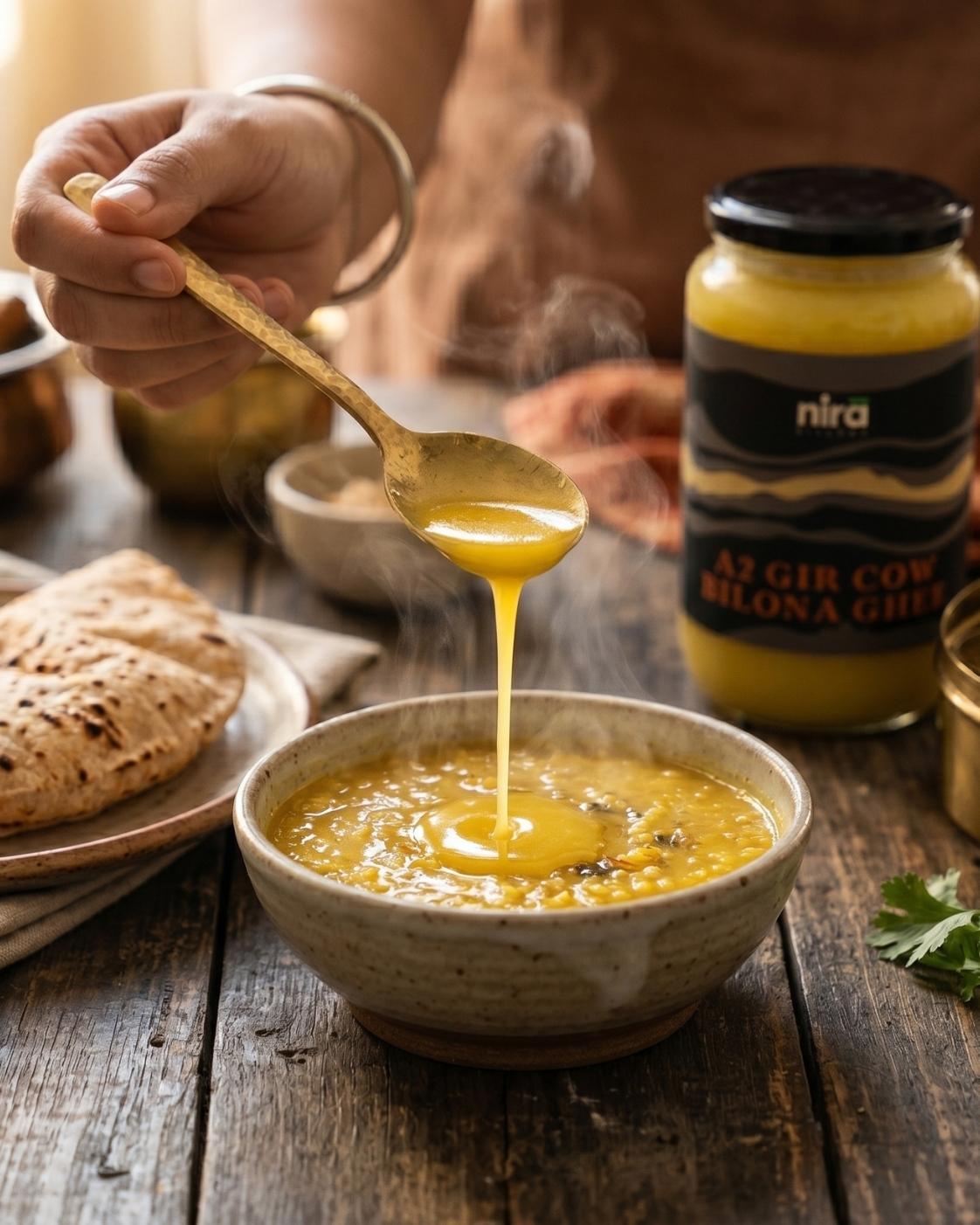
Ask an Indian grandmother about the benefits of ghee and you will hear a long list. Search online and the list gets longer still. Some of it is kitchen wisdom that anyone can see for themselves. Some of it is tradition. And some of it is claims that go well beyond what good studies have shown.
We make ghee, so we are not neutral, and we are not doctors. This guide sticks to what ghee demonstrably does well, what is actually in it, and how to read the bigger claims you will come across.
What ghee is
Ghee is butter cooked slowly until its water has evaporated and its milk solids have browned and been strained off. What remains is almost pure milk fat, with a nutty, toasted flavour. Our guide to ghee in English covers the word itself, and ghee vs butter explains exactly what changes.
The kitchen benefits of ghee
These are the reasons ghee has been the everyday cooking fat of so many Indian kitchens for so long. None of them needs a study; you can see each one at the stove.
- It takes heat. With the milk solids removed, ghee can be heated far past the point where butter burns. That makes it good for frying, for a hot tawa and above all for tadka.
- It carries flavour. Many of the aroma compounds in cumin, mustard seed, curry leaves, hing and chillies dissolve in fat. Bloom them in hot ghee and that flavour spreads through the whole dish. This is the logic of a tadka.
- It tastes of something. Good ghee adds its own nutty, browned-butter flavour. A teaspoon over dal and rice changes the dish in a way a neutral oil does not.
- It keeps without a fridge. With almost no water or milk solids, ghee keeps for months in a cool cupboard in an airtight jar, as long as you use a dry spoon.
- It is easy to use. It is spoonable at room temperature and melts instantly, so it is easy to brush on rotis, stir into khichdi or drizzle over a finished dish.
- It is nearly free of milk solids. Because they are strained out, ghee has only traces of lactose and milk protein. Traces are not zero, so anyone avoiding dairy for medical reasons should ask their doctor.
“The benefits you can see at the stove: it takes heat, it carries spice, it tastes of browned butter and it keeps without a fridge.”
What is in ghee
Ghee is about 99.5 per cent milk fat or more. A tablespoon, about 13 grams, gives roughly 115 to 120 kcal and around 8 grams of saturated fat; a teaspoon, about 5 grams, is roughly 45 kcal. Like butter, ghee contains some fat-soluble vitamins, especially vitamin A, in amounts that vary with the cows' feed and the season.
The plainest point is the most useful one: ghee is a concentrated fat. It is a good fat to cook with, and like any fat, the amount matters. Most Indian dietary guidance suggests keeping total added fats moderate, and if a doctor has told you to limit saturated fat, ghee counts towards that.
Desi ghee, cow ghee, buffalo ghee and A2 ghee
Desi ghee usually just means traditional ghee made in India, as opposed to vanaspati, which is hydrogenated vegetable fat. Beyond that, the label words describe different things.
- Cow ghee is golden-yellow, because cow milk carries beta-carotene into the fat. It is lighter in flavour.
- Buffalo ghee is whiter and often richer, because buffalo milk has more fat. Our guide to the best ghee in India compares them in detail.
- A2 ghee is made from the milk of cows that produce only the A2 type of beta-casein, usually native breeds such as Gir. Our guide to what A2 ghee is explains what that does and does not mean.
- Bilona ghee describes the method: curd churned to butter, butter cooked to ghee. Our guide to bilona ghee covers it step by step.
How people use ghee every day
- Over dal and rice: a teaspoon on top, just before eating.
- In a tadka: heat ghee until it shimmers, add whole spices, and pour it over dal, sabzi or raita.
- On rotis and parathas: brushed on straight off the tawa.
- In sweets: halwa, laddoo, sheera and kheer all lean on ghee for flavour.
- In drinks: blended into black coffee, as in our guide to ghee coffee, or stirred into warm water or milk, as in our guide to ghee with warm water.
How to read the bigger claims
Online, ghee is credited with a long list of benefits, including some said to be specific to women or to men. Some of this comes from Ayurveda, where ghee has an important place. Some comes from personal experience. Very little comes from good studies in people.
We do not repeat those claims, and we would be wary of any brand that does. A few questions help:
- Who is making the claim, and do they sell ghee?
- Is there a study in people, or is it a study in a lab or in animals, or no study at all?
- How much ghee was involved, compared with how much you would actually eat?
- Is ghee being compared with something specific, such as vanaspati, or with nothing?
If you are thinking of ghee for any reason other than taste, talk to a doctor or a registered dietitian. If you want it because it makes food taste better, that is reason enough.
Choosing ghee worth using
Whatever the reason, the benefits only hold if the jar is actually ghee. Look for a single ingredient, cow milk fat or buffalo milk fat, a batch number, a best-before date and, ideally, a lab report from a named laboratory. A Baudouin test, for example, checks for added vegetable fat. Our guide to ghee prices explains what different types should cost, and why a suspiciously cheap jar deserves a closer look.
Questions people ask about the benefits of ghee
- What are the benefits of ghee?
- In the kitchen, ghee takes high heat without burning, carries the flavour of spices in a tadka, adds a nutty browned-butter taste and keeps for months without a fridge. It also has only traces of lactose and milk protein. Many wider claims made for ghee are not well supported by studies in people, so we do not make them.
- Is it good to eat ghee every day?
- Many Indian households use a little ghee every day. It is a concentrated fat, so the amount matters: a teaspoon is about 45 kcal and a tablespoon about 115 to 120 kcal. If a doctor has told you to limit fat or saturated fat, ask them how much is right for you.
- Is cow ghee better than buffalo ghee?
- They are different rather than better or worse. Cow ghee is golden and lighter in flavour; buffalo ghee is whiter and richer. Choose by taste and by how you cook.
- What is desi ghee?
- Desi ghee usually means traditional ghee made from milk in India, as opposed to vanaspati, which is a hydrogenated vegetable fat. It can be made from cow or buffalo milk, by the bilona method or from cream.
- Why does ghee not need a fridge?
- Because it has almost no water or milk solids, which are what let butter spoil. Keep it in a clean, airtight jar in a cool cupboard and always use a dry spoon, and it keeps for months.
Our ghee
nira kitchen's A2 Gir cow bilona ghee is made in the Gir region of Gujarat from the milk of grass-fed Gir cows. A partner dairy sets whole milk into cultured curd, hand-churns it with a wooden bilona and slow-cooks the butter in small batches. Nothing is added. The current price and batch are on the product page.